When Pattern becomes Painting

With the show installation now only two weeks away, final stages of show prep are running at full speed. All the paintings will have their edges painted, a standard practice for me now, after discovering how beneficial the technique is for finalizing the look of a canvas without the need to frame its outside edge with wood. I've been painting on "gallery edge" canvases that provide a thicker side to the canvas acting as a de facto frame. But it is important that these edges are tidy. Instead of painting the entire side, I leave about 1" of white space on the lower half of the side and pull about a brush stroke width of paint over the top half. (The top being the face of the painting) The result gives the painting a little bit of three dimensionality and makes it feel more solid and like less of a flat plane.
Another side benefit of this practice is that allows for time to ruminate on the work before releasing it into the world. Several times now, especially if the work is older, I will be tempted to start reworking elements of the painting during this phase. As a practicing artist, my eye is constantly evolving; the more I practice, the more my visual understanding changes. What I see and respond to today is different than what I saw and responded to a year and a half ago. This repainting, when it occurs, can prolong the edge painting task! And is risky. Once I start reworking a painting it often takes on a new form or identity. Numinosity's Rune, is no exception.
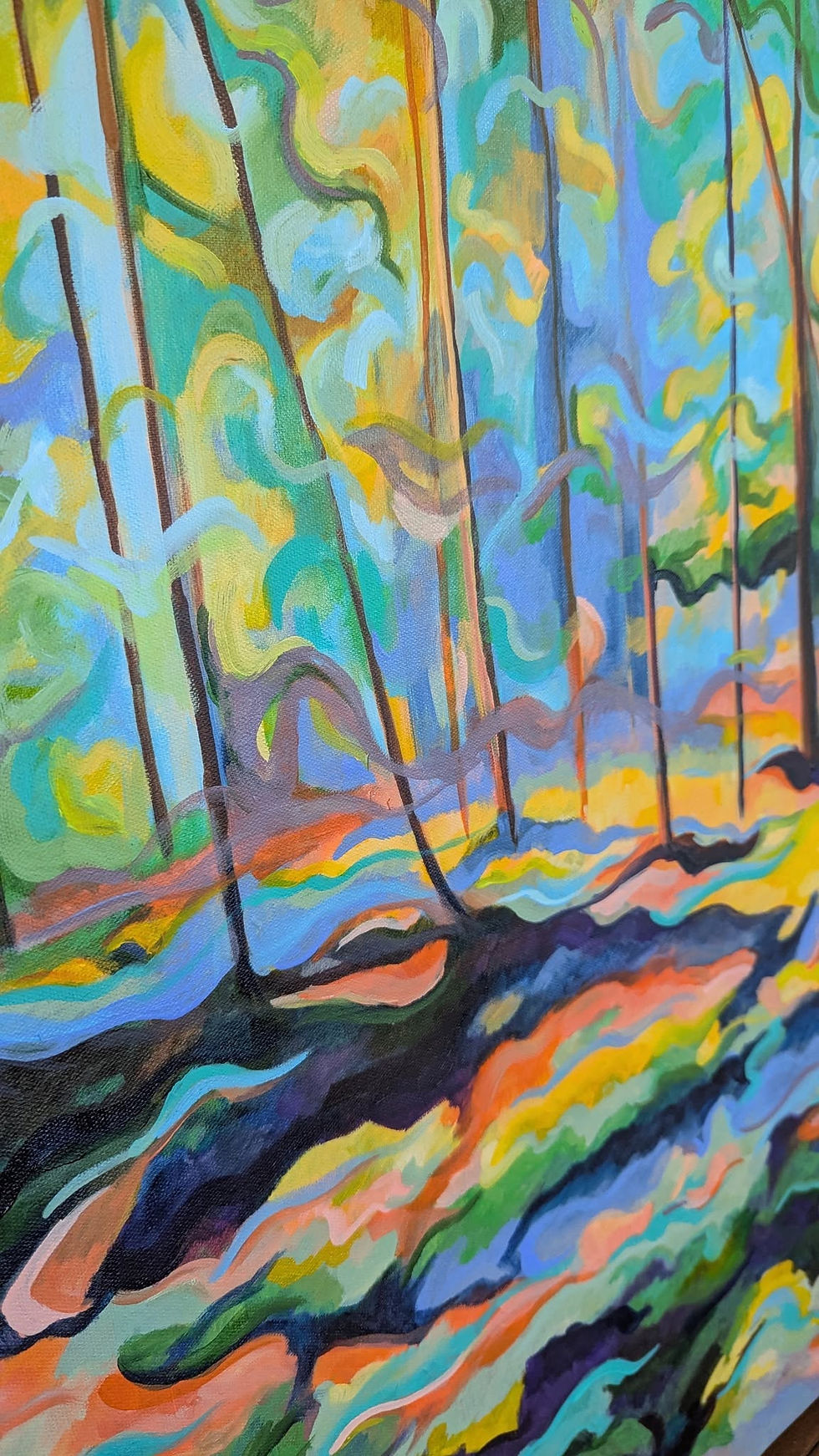
See the image below of the "underpainting" form that existed prior to painting edges. This was one of the first paintings intended for the show, that I stopped midway through, because I didn't want to displace what was happening. The last mark on the piece was in October of 2025. What I loved is the juxtaposition and pairing of dynamic colors: cadmium yellow + dioxazine purple/ cadmium orange + prussian blue/ pale pink + chromium oxide green.

In laying out the show with drafted plans and elevations, I was able to organize my workflow through this visual outline, with an understanding of what goes where and how much space I have as well as the gaps between pieces so essential for the eye in the gallery setting. This painting just didn't fit in the layout, and was a back up in case something happened. At the very least it was planned for the auxiliary show space; the nearby Amherst Cinema allows the gallery to hang a piece of artwork in their main lobby to advertise the show. Since this hadn't been taken through the full pattern making process and represents an early stage of the process, I thought it would be a good candidate for that space.
As I started painting the edges, one thing I noticed is that the thin layers of paint were starting to bother my eye. Up until recently, my painting technique involved watering down the acrylic paint with water to build up thin layers that dried quickly. This past year, I've been trying out different techniques and have started changing my approach, using full brushstrokes full of paint, and thinning by brushing first on a paper towel, or mixing the paint with clear gesso before applying the canvas to suspend the pigment in a clear substrate, allowing the pigment to be forever suspended above others.
With nothing to lose, and time being of the essence, I started applying thicker layers of paint over the most problematic areas. Abandoning any use of gesso, due to time constraints, this painting was adapted using paint in its thickest form. Like any home renovation project, once one improves one area, the adjacent area, which may have looked fine before the renovation started, suddenly looks shabby.
And so it was the same with retouching the painting, one stroke in an area, beget another stroke and another and another. The hours melted away, as the paint was so delicious to apply. There was a fair amount of sitting on the floor looking closely and at angles, and standing up and walking back into the kitchen to look back into the studio to check its overall composition. There were some revisions that happened later, like pulling larger blocks of color through the upper reaches of the composition to increase the contrast and pulsing nature of the flowing forms. Often the brush had multiple layers of paint on it, due to the frenetic application of paint, leading to some joyful discoveries on the canvas. The best part- or human part perhaps, was a happy accident, or at least an accident I chose to embrace and integrate into the work. When trying to squeeze out the last of pale pink from my Liquid acrylic bottle onto my palette, for some judicious swoops in the sky, it exploded and paint shot across and landed on the lower left half of the painting. It was caught in a tufted bed of chromium oxide green and formed parallel angled marks that fit perfectly with the perspective.

Revisiting the original underpainting in this post, I fell a twinge of sadness. That happens sometimes, something is lost along the way and something is gained. But how much had I gained? Could this be Pattern #5 of the series? I ran upstairs to my office and brought the image into illustrator and photoshop to test it out.
Underwhelmed by the results, I decided to hold off on translating it into the pattern and painting kits. The process I had used on the other patterns ended up obliterating the mark making, over simplifying it, and losing all the dendritic water forms. It also helped me see the lack of three tone separation in the work, which is actually one of its strengths. Within the lighter areas, diversity is not achieved through tonal gradients, but instead through different hues or colors within a similar tonal range. As our visual systems process this information, it is both simple and complex at the same time.
This piece is perhaps its own pattern, a triple abstracted work nested within and contained within itself.
Now to paint the edges of the other 4 large canvases. Crossing fingers that I will stay within the edges; any new discoveries will need to wait until after July 1st!


Dear Ms Loeffler, I saw your exhibit today in Amherst. It’s brilliant! “Reducing” the forest to shapes and pattern doesn’t feel like the proper word. Your installation amplifies and expands rather than reduces. I’m excited about maybe trying this “paint-by-number” technique to fix favorite forest places in my memory (although I am no artist.) Thank you for this project. I hope it travels far and wide. PS your paintings are luminous. I love them!