Framing the Painting Kits
Updated: Apr 25

In developing a kit of parts or a suite of tools, it becomes easier to tackle new puzzles. Instead of reinventing the wheel each time, falling back on a kit of parts, individual components can be repurposed based upon their strengths and advantages in order to achieve a novel goal. For the forthcoming July show and recent explorations, the theme of adaptability within the art itself is a strong theme, and how that adaptability is achieved is becoming its on kit of parts.
After putting together a flow chart of all the remaining show prep tasks, I realized it was time to solve the painting kit display question. Each kit has at least 36 individual tiles. Some of the kits I will have pre-painted and will be on display as a sample in the gallery, while others will be on display with an invitation for visitors to pull off a tile and paint it in the gallery and then add back to the wall. For a while I considered magnets as a means to this end, then plexiglass, and then thin plywood. The tiles themselves are mere cardstock, very lightweight and having a system that celebrates their lightness of being seemed like the way to go.
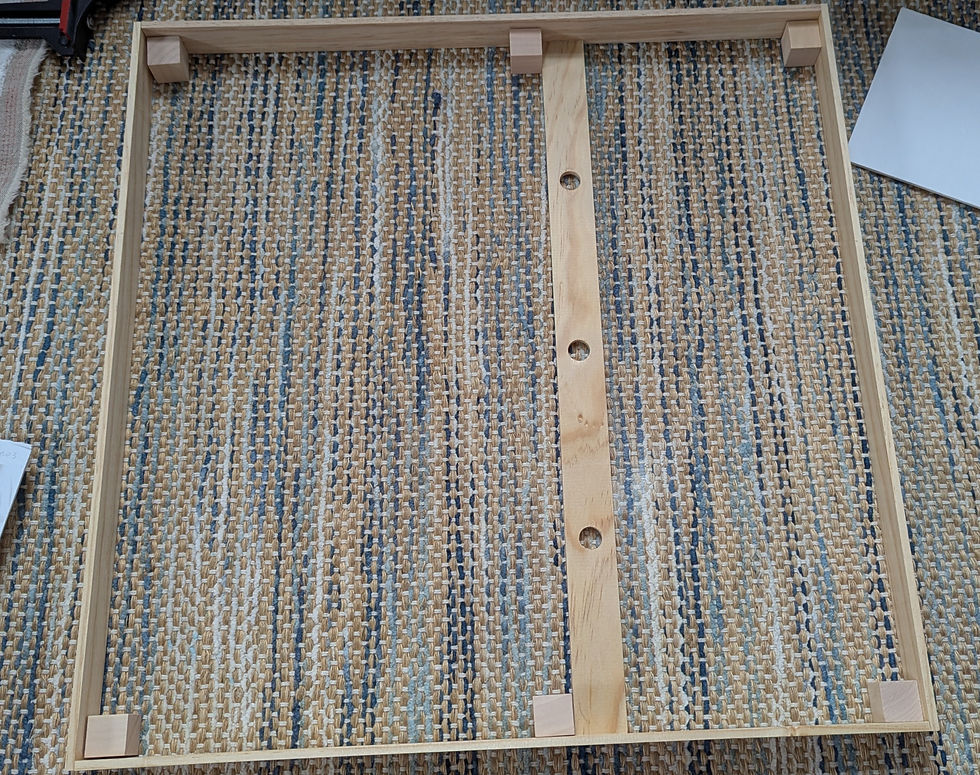
From the most recent kinetic landscape mosaics I had left over 1" x 1" x 1" wood cubes, as well as 1"-3/8" x 1/4" wood strapping. As well as a handy drill press pre set at 5/8" forstner bit size, and 5/8" diameter velcro dots. With this surplus in hand and the skills from recent explorations under my belt, the solution slipped easily into place without much tinkering.
What could be light, but rigid, thin, but strong? I did a couple of tests on scrap foam core with velcro and tiles and confirmed the foam core was rigid enough and the velcro was sticky enough to each perform the perfect role in this collaboration. Also taking from the scribing technique I used to transfer the pattern to the larger artacus painted tiles, I used the scribe here to press in marks for the corners of the grid as well as the center locations for each dot.

Next I pressed the cards onto the sticky backs of the preset velcro tabs, and I was in business. This is probably the fastest framing system to date!

The rest went fairly quickly as anything art related might go, in that it went smoothly, without hiccups. The slowest bit was waiting for the glue to dry overnight before moving onto the next sequence of gluing. The foam core slips right into the frame, and the frame is hung independently of the foam core, allowing both the foam core to be swapped out in the future as well as the individual tiles.


Comments